In distributed systems, generating unique identifiers sounds simple — until your application scales across multiple servers, databases, regions, and services.
At the scale of platforms like Twitter, Discord, Instagram, or TikTok, traditional database-generated IDs quickly become a bottleneck. Systems processing millions of requests every second require an ID generation strategy that is fast, distributed, and globally unique.
This is exactly the problem Twitter attempted to solve in 2010 with Snowflake: a distributed, time-sortable, high-performance ID generation algorithm.
Today, Snowflake-inspired systems power many modern backend architectures across social media, cloud infrastructure, analytics pipelines, and microservices.
This article explains how Snowflake IDs work internally, why they became so popular, their advantages and limitations, and the engineering challenges behind distributed ID generation.
Why Traditional Auto-Increment IDs Break at Scale
In small applications, auto-incrementing database IDs are perfectly acceptable.
Example:
ID | Username |
1 | john |
2 | jane |
3 | jack |
The database simply increases the ID every time a new record is inserted.
However, this approach becomes problematic in distributed systems.
Imagine running:
Multiple backend servers
Multiple database instances
Multiple regions or data centers
If all systems attempt to generate IDs independently, collisions become inevitable unless strict coordination exists.
Traditional auto-increment systems introduce several architectural problems:
Centralized bottlenecks
Write contention
Replication delays
Difficult database sharding
Cross-region synchronization complexity
Even assigning separate ID ranges per server becomes difficult to maintain as infrastructure scales dynamically.
Additionally, auto-increment IDs contain almost no useful metadata:
No timestamp information
No node identification
No distributed traceability
As systems grow horizontally, backend engineers often seek distributed alternatives.
UUIDs: A Popular Alternative
UUIDs (Universally Unique Identifiers) are one of the most common solutions.
Example:
67DB31FB-1887-4372-A8B0-E87C092D7D11
UUIDs provide:
Extremely low collision probability
Decentralized generation
Global uniqueness
However, they also introduce trade-offs.
Type | Advantages | Limitations |
AUTO_INCREMENT | Simple and compact | Centralized bottleneck |
UUID v4 | Globally unique | Large and unsortable |
ULID | Sortable and distributed | Longer string format |
Snowflake | Distributed, sortable, compact | Requires clock synchronization |
The biggest drawback of UUID v4 is randomness.
Because UUIDs are not naturally ordered:
Database indexes fragment more easily
Insert performance decreases
Sorting becomes less efficient
Snowflake IDs were designed specifically to solve these issues.
What is a Snowflake ID?
Snowflake is a distributed ID generation algorithm originally developed by Twitter.
Its goals were straightforward:
Generate globally unique IDs
Support distributed systems
Avoid centralized databases
Preserve chronological ordering
Maintain extremely high performance
Unlike UUIDs, Snowflake IDs are compact 64-bit integers.
Each node in the infrastructure can independently generate IDs without contacting a central coordination service.
This makes Snowflake extremely scalable.
Snowflake ID Structure
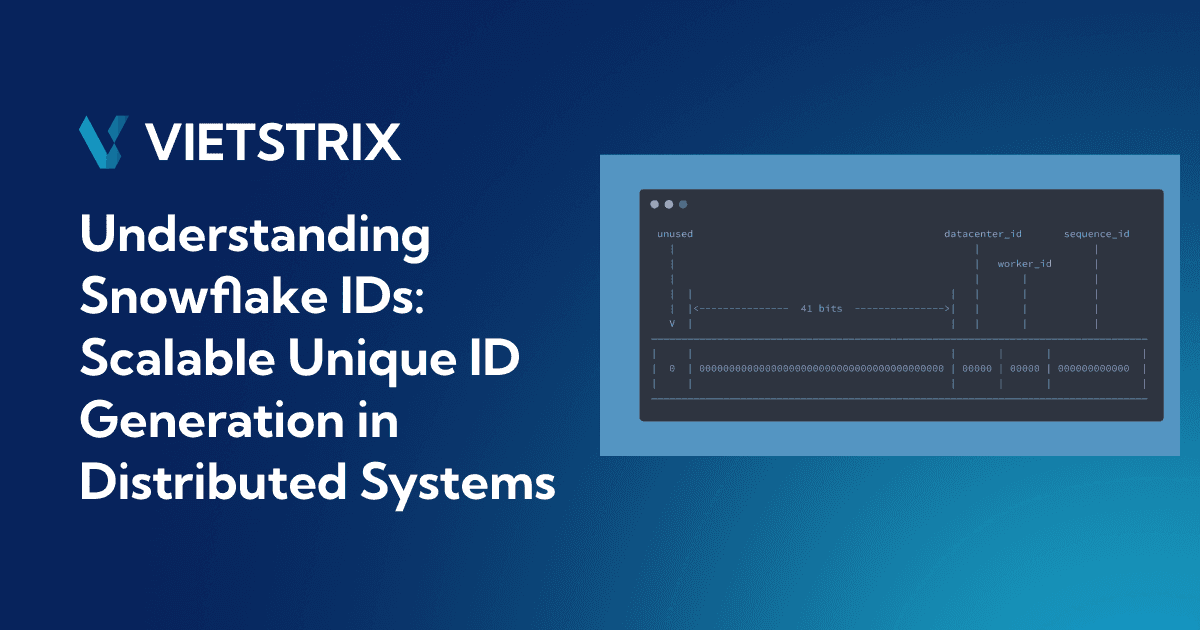
A Snowflake ID consists of 64 bits divided into several sections.
| 1 Bit Sign | 41 Bits Timestamp | 10 Bits Machine ID | 12 Bits Sequence |
Component | Bits | Description |
Sign Bit | 1 | Always 0 to keep IDs positive |
Timestamp | 41 | Milliseconds since a custom epoch |
Machine ID | 10 | Identifies the server/node |
Sequence | 12 | Counter for IDs generated within the same millisecond |
Timestamp
The timestamp stores milliseconds elapsed since a custom epoch.
With 41 bits:
2^{41} \approx 69\text{ years}
This allows Snowflake systems to operate for decades before timestamp overflow occurs.
Because timestamps occupy the highest significant bits, Snowflake IDs remain naturally sortable by creation time.
This means:
Higher ID = newer record
Machine ID
The machine ID identifies which server generated the ID.
With 10 bits:
2^{10}=1024\text{ nodes}
This allows large distributed infrastructures to independently generate IDs without collisions.
Sequence
The sequence counter increments when multiple IDs are generated within the same millisecond.
With 12 bits:
2^{12}=4096\text{ IDs/ms/node}
Combined across many nodes, this enables millions of IDs to be generated every second.
How Snowflake ID Generation Works
When a service needs a new ID, the algorithm follows several steps:
Get the current timestamp in milliseconds
Compare it with the previous timestamp
If still within the same millisecond:
Increment the sequence number
If the sequence exceeds 4095:
Wait until the next millisecond
Combine all sections into a single 64-bit integer
This process avoids:
Database queries
Distributed locks
Central coordination
As a result, Snowflake generation is extremely fast and highly scalable.
Why Snowflake IDs Are Time Sortable
One of Snowflake’s most powerful features is chronological ordering.
Because timestamps occupy the highest bits, IDs naturally sort by creation time.
This property is extremely useful for:
Chat systems
Social feeds
Event streams
Distributed logging
Analytics pipelines
Message queues
Many systems can determine record order simply by comparing ID values.
In some architectures, engineers can even extract timestamps directly from the ID itself.
Example:
(timestamp << 22) + machineId + sequence
This reduces dependency on separate ordering mechanisms.
Distributed Nodes and Workers
Many Snowflake implementations organize generation into:
Nodes
Workers
Services
Example architecture:
Node | Worker | Responsibility |
API Server | Worker 1 | User IDs |
API Server | Worker 2 | Post IDs |
Notification Service | Worker 1 | Notification IDs |
Logging Service | Worker 1 | Event IDs |
This design allows engineers to identify:
Which service generated the ID
Which worker created it
When it was created
This becomes valuable for debugging and distributed tracing.
Real-World Challenges in Snowflake Systems
Although Snowflake is elegant, production systems still face operational challenges.
Clock Drift
Snowflake heavily depends on system time.
If a server clock moves backwards because of:
NTP synchronization
Virtual machine issues
Manual clock changes
the generator may produce invalid or duplicate IDs.
Many implementations solve this by:
Temporarily rejecting generation
Waiting until clocks recover
Using monotonic clocks internally
Sequence Overflow
Each node can only generate:
4096\text{ IDs per millisecond}
per worker.
If traffic exceeds this limit:
The generator must wait
Or distribute generation across additional workers/nodes
At massive scale, infrastructures often expand horizontally to avoid bottlenecks.
Duplicate Machine IDs
If two servers accidentally share the same machine ID, collisions become possible.
This requires careful infrastructure coordination.
Large systems often manage machine IDs using:
Kubernetes StatefulSets
Service discovery
Configuration management systems
JavaScript Numbers Have a Precision Problem
One of the most overlooked Snowflake issues appears in JavaScript.
Example:
console.log(144328692659220481)
Output:
144328692659220480
The value changes unexpectedly.
This happens because JavaScript uses IEEE-754 double-precision floating point numbers.
JavaScript safely supports integers only up to:
2^{53}-1
Any larger integer may lose precision.
This creates major problems for Snowflake IDs because they commonly exceed JavaScript’s safe integer range.
Why Large Systems Return Snowflake IDs as Strings
Because of precision limitations, many large systems return Snowflake IDs as strings instead of numbers.
Correct:
{
"id": "144328692659220481"
}
Unsafe:
{
"id": 144328692659220481
}
This is why APIs from systems like Discord often return IDs as strings.
Internally, systems may still use:
bigint
uint64
int64
depending on the programming language.
When calculations are needed in JavaScript or TypeScript:
const id = BigInt("144328692659220481")
This preserves full precision safely.
Simple Node.js Snowflake Implementation
Below is a simplified Snowflake implementation in Node.js.
class Snowflake {
constructor(workerId, datacenterId, sequence = 0n) {
this.workerId = BigInt(workerId);
this.datacenterId = BigInt(datacenterId);
this.sequence = sequence;
this.twepoch = 1288834974657n;
this.workerIdBits = 5n;
this.datacenterIdBits = 5n;
this.sequenceBits = 12n;
this.sequenceMask = -1n ^ (-1n << this.sequenceBits);
this.workerIdShift = this.sequenceBits;
this.datacenterIdShift =
this.sequenceBits + this.workerIdBits;
this.timestampLeftShift =
this.sequenceBits +
this.workerIdBits +
this.datacenterIdBits;
this.lastTimestamp = -1n;
}
tilNextMillis(lastTimestamp) {
let timestamp = BigInt(Date.now());
while (timestamp <= lastTimestamp) {
timestamp = BigInt(Date.now());
}
return timestamp;
}
nextId() {
let timestamp = BigInt(Date.now());
if (timestamp < this.lastTimestamp) {
throw new Error("Clock moved backwards");
}
if (timestamp === this.lastTimestamp) {
this.sequence =
(this.sequence + 1n) &
this.sequenceMask;
if (this.sequence === 0n) {
timestamp = this.tilNextMillis(
this.lastTimestamp
);
}
} else {
this.sequence = 0n;
}
this.lastTimestamp = timestamp;
return (
((timestamp - this.twepoch)
<< this.timestampLeftShift) |
(this.datacenterId
<< this.datacenterIdShift) |
(this.workerId
<< this.workerIdShift) |
this.sequence
);
}
}
const snowflake = new Snowflake(1, 1);
console.log(snowflake.nextId().toString());
Example output:
159488555397410304
Snowflake vs UUID vs ULID
Feature | AUTO_INCREMENT | UUID v4 | ULID | Snowflake |
Globally Unique | No | Yes | Yes | Yes |
Distributed | No | Yes | Yes | Yes |
Sortable | Yes | No | Yes | Yes |
Compact | Yes | No | Medium | Yes |
High Write Performance | Medium | Low | Medium | High |
Real-World Adoption
Many major platforms use Snowflake or similar distributed ID generators.
Company | System |
Original Snowflake | |
Discord | Snowflake IDs |
Instagram / Meta | Time-based distributed IDs |
TikTok | Internal distributed generators |
Alibaba | Leaf ID Generator |
These infrastructures rely heavily on:
Horizontal scaling
Distributed microservices
High-throughput event pipelines
When Should You Use Snowflake IDs?
Snowflake is a good choice if:
Your backend is distributed
You operate multiple services or nodes
You need sortable IDs
You want to avoid centralized bottlenecks
You require high-throughput ID generation
Snowflake may not be ideal if:
You need cryptographically unpredictable IDs
Your infrastructure has unreliable clocks
Your system is relatively small
You need opaque public identifiers
In some cases, UUIDs remain the better choice.
Best Practices
Recommended
Return Snowflake IDs as strings in APIs
Use bigint internally when necessary
Synchronize clocks using NTP
Carefully manage worker and machine IDs
Monitor sequence overflow
Implement rollback protection for clocks
Avoid
Treating Snowflake IDs as normal JavaScript numbers
Reusing machine IDs accidentally
Exposing predictable IDs publicly when enumeration matters
Depending on unsynchronized clocks
Conclusion
Snowflake IDs remain one of the most elegant ideas in distributed backend engineering.
They solve a deceptively difficult problem:
generating globally unique, chronologically sortable IDs without relying on centralized infrastructure.
Their design balances:
Scalability
Performance
Ordering
Compact storage
Distributed independence
This is why Snowflake-style generators continue to power some of the world’s largest platforms — from social media systems to analytics pipelines and modern microservice architectures.
For backend engineers building distributed systems, Snowflake is no longer just an implementation detail. It is a foundational concept worth understanding deeply.