What is Scaling in Distributed Systems? Scale Up vs. Scale Out Explained for Developers
Imagine this: Your e-commerce system suddenly receives 10 times its normal traffic during a massive sale event like Black Friday. Servers overload, the website keeps spinning, users are frustrated, and revenue vanishes in the blink of an eye. In these critical, "hanging by a thread" situations, the solution isn't to sit and pray the system comes back to life; the solution is Scaling.
But what exactly is Scaling in a distributed system? And when faced with the need to expand, should developers choose a Scale Up (vertical) or Scale Out (horizontal) strategy? Let's dive into the core concepts and real-world engineering experiences in the article below.
1. What is "Scaling" in Distributed Systems?
In software engineering, "Scaling" in Distributed Systems refers to the system's ability to efficiently handle a growing amount of work, data, or user traffic by adding resources to the system. Crucially, this expansion process must not degrade the performance or the reliability of the entire application.
When designing software architecture, the ultimate goal of scaling always revolves around two key factors:
High Availability: The system remains alive and functional even if individual components or servers fail.
Performance: Response times (latency) remain low even when millions of users access the system concurrently.
2. Detailed Comparison: Scale Up (Vertical) vs. Scale Out (Horizontal)
In the tech world, scaling is typically divided into two core strategies. To easily visualize this, imagine your application is a wildly popular retail store:
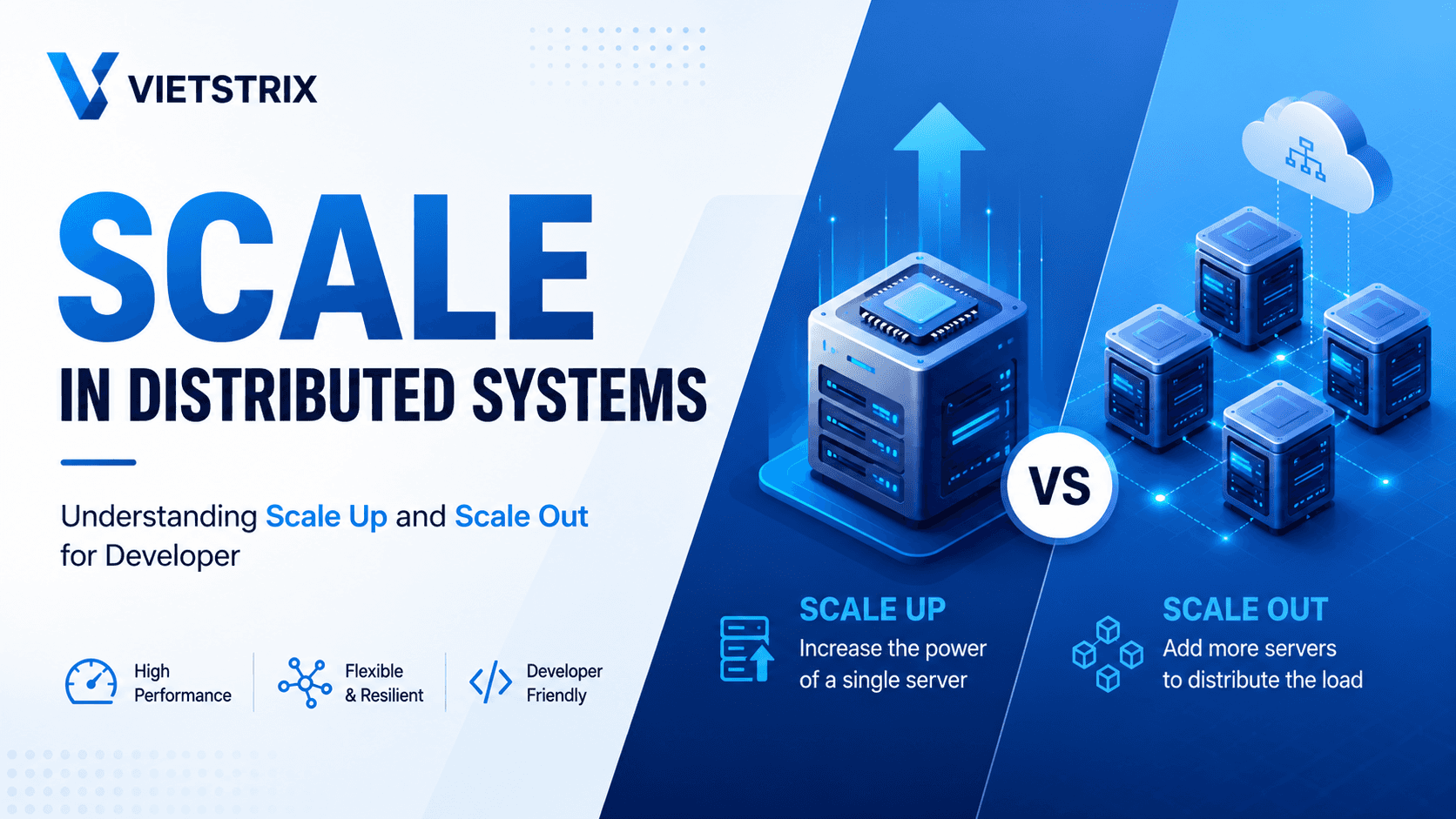
Scale Up (Vertical Scaling): You tear down the store and build a skyscraper on the exact same foundation.
Scale Out (Horizontal Scaling): You rent adjacent properties and open a chain of smaller stores; when it gets crowded, you route customers to the next door.
Here is a detailed comparison table:
Criteria | Scale Up (Vertical Scaling) | Scale Out (Horizontal Scaling) |
|---|---|---|
Core Concept | Upgrading the "muscle" of an existing server (adding RAM, CPU, SSD). | Adding "manpower" (new servers/nodes) to the system network. |
Limitations | Strict physical ceiling (a motherboard can only hold so much RAM/CPU). | Virtually limitless. |
Fault Tolerance | Poor. If the single server crashes (Single Point of Failure), the whole system goes down. | Excellent. If one node dies, other nodes automatically take over the load. |
Maintenance / Downtime | Usually requires shutting down the machine to upgrade hardware (downtime is mandatory). | New machines can be added or removed while the system is running (Zero downtime). |
Cost | Increases exponentially when buying high-end components (e.g., one 256GB RAM stick is far more expensive than four 64GB sticks). | Increases linearly (pay-as-you-go, can utilize commodity servers). |
3. Why is Scale Out the "Ultimate Weapon" of Distributed Systems?
The true power and essence of a Distributed System lie in Scale Out. This architecture was born so that many smaller computers could join forces to solve a massive problem that no single "supercomputer" (achieved via Scale Up) could handle alone.
There are two main reasons software engineers prioritize Scale Out:
Eradicating SPOF (Single Point of Failure): In Scale Up, you put all your eggs in one basket. If the power supply fails, the entire service evaporates. With Scale Out, you might have 10 servers. If 2 servers die, the remaining 8 continue to serve users, ensuring an uninterrupted experience.
The Power of Load Balancers: For Scale Out to work, your system requires a component called a Load Balancer. It acts like a traffic cop, automatically detecting which servers are idle to route user requests there, ensuring the system never experiences localized overload.
4. Real-World Experience: Lessons from Large-Scale Projects
Look at how Netflix or Shopee handle billions of requests daily. They don't buy one gigantic super-server. Instead, they break their applications down into independent services (Microservices) and apply a Scale Out strategy (e.g., using Kubernetes) to continuously replicate containers when traffic spikes.
At Vietstrix, during our technology consulting and implementation processes, we have encountered many projects that started with Scale Up due to its simplicity. However, as the database bloated and the user base surpassed hundreds of thousands, the cost of maintaining a "monster" server became a massive burden, and the risk of system failure was simply too high. The solution is always to refactor and gradually migrate to a distributed Scale Out architecture.
5. Conclusion: When to Use Which?
To make the right decision, you can apply the following Rule of Thumb:
Choose Scale Up when: The project is in its early stages (MVP), traffic is low, the application architecture is simple (Monolithic), or you are using a relational database (RDBMS) at a moderate scale and lack a strong DevOps team. It saves you configuration time.
Mandatory to choose Scale Out when: The system is large, traffic grows unpredictably, massive data requires parallel processing, and the system demands an uptime of up to 99.99%.
Understanding exactly what scaling in distributed systems is is the first step to building a robust application. If you or your business are facing difficult challenges in designing high-performance system architectures or optimizing server infrastructure, do not hesitate to contact the Vietstrix team for the most in-depth support and consulting.
References:
AWS Architecture documentation on Scaling: aws.amazon.com/architecture
Articles on Distributed Systems by expert Martin Fowler: martinfowler.com