
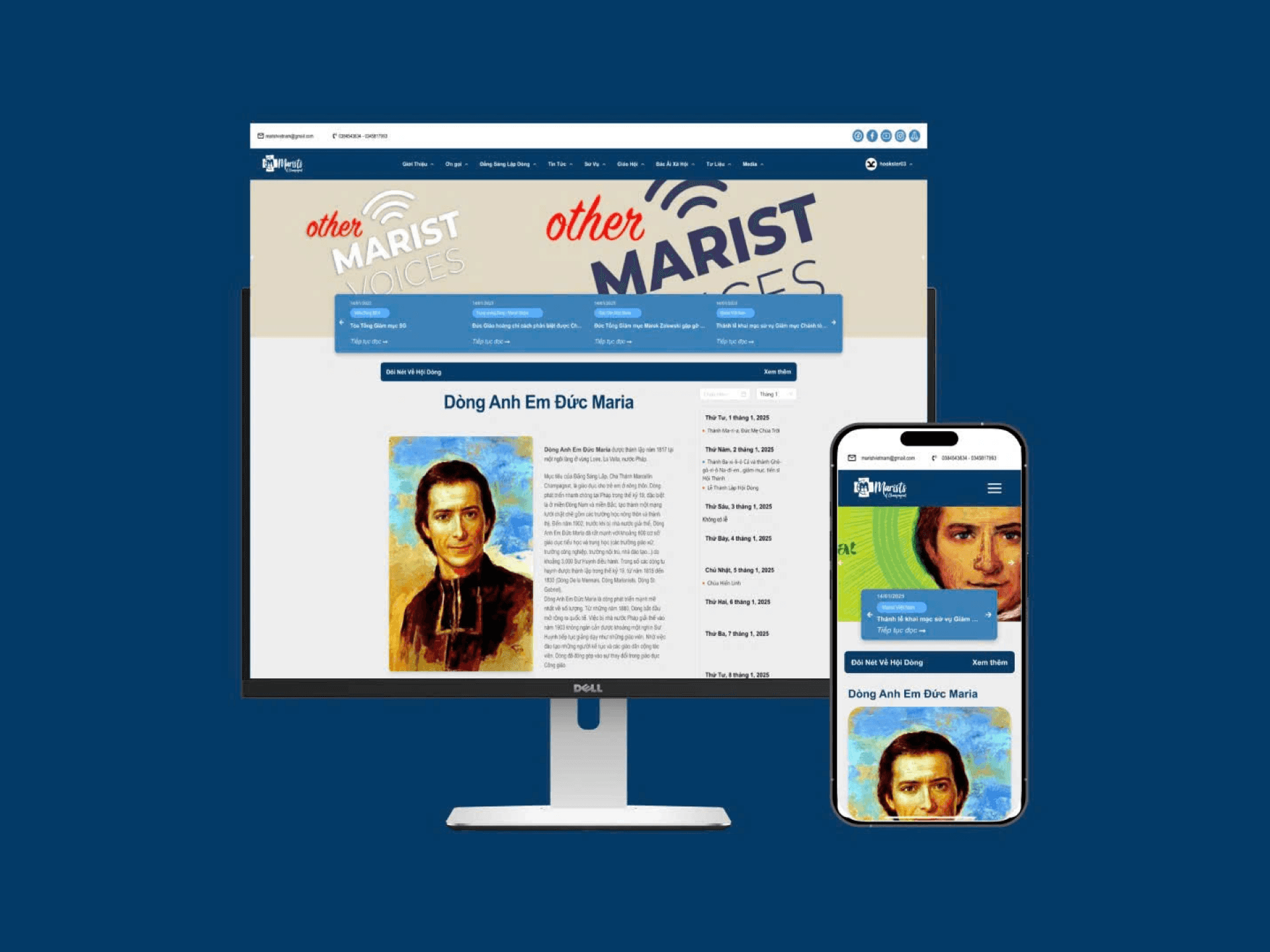
Project Case Study: hoidonganhemducmaria.com
The Official Digital Platform of the Congregation of the Brothers of Mary
Project Overview
hoidonganhemducmaria.com is the official web platform developed to support the communications, content management, and community engagement initiatives of the Congregation of the Brothers of Mary (Hội Dòng Anh Em Đức Maria).
The project was launched to build a comprehensive, modern digital ecosystem tailored to a unique set of institutional requirements:
Solemn, standards-compliant, and accessible user interface.
Optimized reading experience catering to diverse age groups.
High-speed page loading performance, even on lower-end devices.
Intuitive and streamlined Content Management System (CMS).
Technical SEO to maximize organic visibility and trust.
Stable, secure, and scalable system architecture.
Far beyond a simple promotional website, this platform is engineered as a sustainable, long-term digital asset for the congregation.

1. Background and Real-World Challenges
Prior to this project, most of the congregation's information and documents were managed through traditional, fragmented, and unsynchronized channels. This legacy approach led to several key challenges:
Content was difficult to access and navigate on mobile devices.
Inefficiencies in organizing and retrieving a massive library of articles and documents.
Lack of a centralized platform for real-time updates.
Suboptimal search engine visibility.
Inconsistent user experiences across different screen sizes.
Importantly, a significant portion of the platform’s target audience includes elderly members. Ensuring the system remains highly intuitive, readable, and straightforward to navigate was the most critical challenge during the design and development phases.
2. UX/UI & User Experience Research
Before writing any code, the user experience framework was thoroughly researched based on the actual browsing behavior of the target audience.
Design Principles
The website adopts a Minimalist approach to deliver a feel that is:
Solemn and respectful
Highly readable
Content-centric
Comfortable during extended reading sessions
The color palette features soft, muted tones that convey trust and align perfectly with the congregation's identity. Spacing and layouts are structured around a modern Grid system to enhance readability for long-form articles without causing eye strain.

Accessibility Enhancements
The UI layout is optimized for accessibility with:
Clear, legible typography and customizable font sizing.
High-contrast color ratios.
Simple, intuitive navigation bars.
Straightforward, logical layouts that eliminate complex interactions.
Using Responsive Design principles, the platform guarantees a seamless and stable display across all device types, including smartphones, tablets, laptops, and desktops.
3. Technical Challenges & Solutions
To ensure long-term viability, the project had to balance aesthetic elegance with complex technical performance, SEO, and operational challenges:
Handling High-Volume Dynamic Content: Processing and serving large amounts of articles and media efficiently.
Low-Bandwidth Optimization: Keeping the site lightning-fast even on slow 3G/4G connections.
Technical SEO: Programmatically optimizing search engine indexing for every individual post.
Non-Technical CMS Management: Simplifying the backend admin panel so non-tech-savvy users can manage the site smoothly.
Extensibility: Keeping the architecture modular to easily plug in new features.
Security & Reliability: Hardening the production environment against potential vulnerabilities.
To solve these, the entire system was designed with a modular structure and performance-first architecture from day one.
4. Technology Architecture
The platform is built on a decoupled Frontend/Backend separation model to maximize scalability, maintainability, and deployment efficiency.
Frontend
Core Technologies: Next.js, ReactJS, TailwindCSS.
Rendering Strategy: Dynamic Rendering (Server-Side Rendering / Static Site Generation mix).
Optimization Techniques: Responsive UI System, Lazy Loading, and Dynamic Imports.
The frontend ensures rapid page rendering, optimal SEO crawlability, and fluid user interactions across all modern browsers.
Backend
Core Language: Golang.
Architecture: RESTful API, Middleware Architecture.
Security Layer: JWT Authentication, Input Validation & Security Layer.
The Go-based backend is lightweight, highly performant, and capable of handling high concurrent traffic with minimal server overhead.
Infrastructure & Deployment
Containerization: Docker.
Web Server / Proxy: Nginx Reverse Proxy.
Environment: Ubuntu VPS.
Security Protocols: SSL/TLS Encryption.
Containerizing the application ensures consistent environments between staging and production, facilitates easy backups, reduces configuration errors, and guarantees long-term operational uptime.
5. SEO & Performance Optimization
A major priority of the project was ensuring strong organic visibility on Google and a pristine page-load experience.
Technical SEO Implementations
Server-Side Rendering (SSR) for instant search-engine indexing.
Dynamic Metadata customized per article and page.
Semantic HTML Markup following SEO best practices.
Automated XML Sitemap generation.
Optimized Robots.txt configuration.
OpenGraph & Social Preview tag integration for rich social sharing.
Strict Heading Structure (H1–H6) optimization.
Strategic Internal Linking framework.
Performance & Core Web Vitals
High-speed responsiveness is achieved through:
Image Optimization: Automatically converting assets to next-gen WebP formats.
Lazy Loading Assets: Postponing non-critical asset loads.
Caching Layers: Reducing redundant database hits.
Asset Compression: Minifying and compressing code bundles.
Preloading Critical Resources: Serving key visual assets first to optimize Core Web Vitals (LCP, FID, CLS).
6. Content Management System (CMS)
One of the most important objectives was empowering the congregation's editorial team to manage content independently without needing technical expertise.
The CMS was heavily customized to feature:
An integrated, industry-standard Rich Text (WYSIWYG) Editor supporting custom headers, lists, links, media embeds, and table formats seamlessly.
Effortless article creation and publishing workflows.
Fast, drag-and-drop image uploading with automatic responsive formatting.
Flexible category and tag management.
Role-based access control (RBAC) for site administrators.
This bespoke administration panel has drastically reduced post-handover technical support requests.
7. Interactive and Community Engagement Module
Beyond publishing static content, the platform includes interactive, secure features designed to foster a closer relationship between the congregation and its community:
Secure online contact and inquiry forms.
A feedback submission system.
Structured, user-friendly informational flow.
Optimized layout pathways to guide users to essential announcements.
All community-submitted data is encrypted, processed securely, and delivered to the admin dashboard in real-time.
8. Key Outcomes & Post-Launch Impact
Following rigorous testing and quality assurance, the platform successfully launched with immediate, positive results:
High Speed & Stability: Outstanding performance across all device types and networks.
Comfortable Reading Experience: Excellent legibility and visual comfort for long-form content.
Superior SEO & Domain Trust: Rapid search engine indexing, strong E-E-A-T signals, and improved organic rankings.
Unified Visuals: Consistent user interface rendering on screens of all sizes.
Operational Autonomy: The administrative team is fully self-sufficient in daily publishing using the intuitive Rich Text tools.
Future-Proof Design: The decoupled API-driven architecture stands ready to support future mobile apps or web modules.
Today, hoidonganhemducmaria.com serves as a vital digital asset, elevating the congregation’s communication capabilities and building a professional, lasting online presence.
